The Red Hat Ecosystem Catalog is the official source for discovering and learning more about the Red Hat Ecosystem of both Red Hat and certified third-party products and services.
We’re the world’s leading provider of enterprise open source solutions—including Linux, cloud, container, and Kubernetes. We deliver hardened solutions that make it easier for enterprises to work across platforms and environments, from the core datacenter to the network edge.

The Cisco® Mobility Services Gateway or MSG, an any-G based Packet Core solution, enables seamlessly deployment of 5G services alongside their existing 2G, 3G, and 4G networks.
The Cisco® Mobility Services Gateway or MSG, an any-G based Packet Core solution, enables Communication Service Providers (CSPs) to seamlessly deploy 5G services alongside their existing 2G, 3G, and 4G networks by providing an evolutionary path to adopting the new 5G RAT and associated services. CSPs can accelerate new revenue opportunities and streamline operations without losing support and functionality with previous mobile network generations. With capabilities like automated configuration and lifecycle management, advanced user plane technologies with persona-based customization, 3GPP-compliant handover support across network generations, and unified observability features, CSPs can effectively meet current and ever changing market requirements.
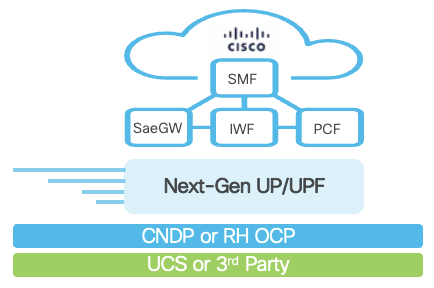
Cisco Mobility Services Gateway simplifies the management of 2G, 3G, 4G, and 5G networks by supporting deployment on the Cisco Cloud-Native Deployment Platform (CNDP) across all the MSG Control-Plane and User-Plane components, streamlining operations across various network generations.
Integration of this gateway with Cisco Provider Connectivity Assurance (PCA) offers enhanced observability that helps ensure network reliability and performance for CSPs across all network generations that the gateway supports.
The close integration of this gateway with Cisco’s cloud-native User Plane Function (UPF), built on a microservices architecture, enables CSPs to benefit from rolling upgrades that provide uninterrupted service availability and enhanced throughputs. Additionally, the UPF supports flexible resource allocation for diverse use cases like fixed wireless access and telematics.
CSPs can automate configuration and lifecycle management across the Mobility Services Gateway components using a single function pack with Cisco Crosswork® Network Services Orchestrator (NSO), enhancing operational efficiency and reducing complexity in managing both non-5G and 5G services.
The Mobility Services Gateway helps ensure seamless connectivity for customers by supporting 3GPP-compliant handovers between network generations.
The Mobility Services Gateway maintains functional parity with existing Cisco CUPS for non-5G services, providing our customers a seamless transition path toward 5G SA.
This matrix displays product versions and their claimed compatibility with Red Hat platforms, as provided by the partner through Partner Validations and the Red Hat Certifications.
| Partner product version | Red Hat platform | Certification type |
|---|---|---|
2026.01.0.i16 | Red Hat OpenShift Container Platform 4.20 | |
2026.01.0.i16 | Red Hat OpenShift Container Platform 4.20 |
Red Hat certified products are tested to meet Red Hat’s criteria and supported as defined in the Red Hat Collaborative Support Process.
Partner validated products are tested by Red Hat Partners and supported as defined in the Red Hat Third Party Component Policy.
| Product | Partner product version | Certification type | Level | |
|---|---|---|---|---|
Red Hat OpenShift Container Platform 4.20 Architecture: x86_64 View Kbase | 2026.01.0.i16 | RHOCP 4 CNF | ||
· The Mobility Services Gateway supports 3GPP-compliant handovers across network generations. The EPC GW supports handovers for non-5G users across 2G, 3G, and 4G. For example, a 4G subscribed user can attach to or move between 2G, 3G, and 4G access networks. The 5GSA GW supports handovers for 5G users across 2G, 3G, 4G, and 5G. Table1 shows the supported handovers.
Both components of the Mobility Services Gateway, the EPC GW and 5GSA GW, can be configured using a single function pack with Cisco Crosswork Network Services Orchestrator (NSO). Currently the function pack used by NSO to configure and manage 4G services (4G-CUPS) is different from the function pack used for 5G SA services (SMF). The unification of function packs provides operational efficiency and ease of management across both non-5G and 5G networks.
As part of the full adoption of the Red Hat OpenShift framework, Cisco is also providing an update to the standard Automation/Orchestration framework above by supporting the Git Automation built into OpenShift. This functionality will streamline Cisco and 3rd party CNFs for onboarding & lifecycle management.
Currently, most existing Cisco operators with Cisco 4G-CUPS or ASR5500 based monolithic Packet data network Gateway (PGW) depend on bulk statistics generated by these nodes to oversee network operations. With the Mobility Services Gateway, CSPs can achieve a unified and efficient monitoring strategy by integrating bulk statistics from the EPC GW for non-5G users alongside Prometheus-based metrics & telemetry from the 5GSA GW for 5G users, all within a single Grafana dashboard. This consolidated approach enhances operational efficiency and simplifies the monitoring process, offering customers a more streamlined and effective method of managing their network environments.
The Mobility Services Gateway’s capabilities extend beyond monitoring to provide observability solutions to customers by seamlessly integrating with Cisco’s Provider Connectivity Assurance (PCA). This integration unlocks a wide array of features offered by PCA for enhanced observability, enabling comprehensive monitoring across all network generation sessions managed by the gateway. Such robust observability is crucial for optimizing network performance monitoring and management, providing CSPs with superior tools to help ensure efficient and effective network operations. Cisco PCA seamlessly integrates with CSPs’ performance and fault management systems via northbound interfaces, allowing the transmission of Key Performance Indicators (KPIs), alarms over HTTP/HTTP2, Secure Shell FTP (SFTP) files, and alert notifications.